


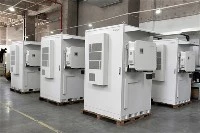
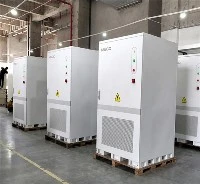
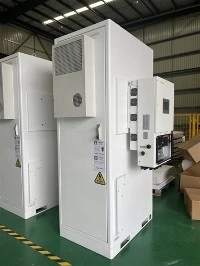
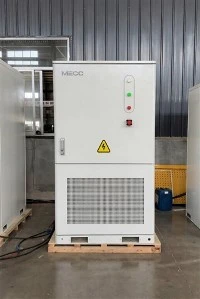
Two batteries can carry the same nameplate capacity and behave completely differently. One can deliver a 500 kW burst for twenty minutes; the other sips 100 kW for five hours. The difference isn't the size - it's the C-rate system's shape. Getting the power-to-energy ratio design. Here's how to pick the right one.

What C-rate and duration mean
C-rate expresses power relative to energy. A 1C system discharges its full capacity in one hour; 0.5C takes two hours; 2C empties in thirty minutes. is simply the inverse - the hours a battery can sustain its rated power. Power-to-energy ratioenergy-to-power ratio) is the same idea expressed as a fraction: a 1 MW / 2 MWh system has a 0.5 P/E ratio and a 2-hour duration.
These three terms describe one underlying property: how fast the battery can spend its energy.
tells you how much energy the battery holds. The C-rate tells you how fast it can move. A large tank with a narrow spout can't shave a sharp spike; a small tank with a wide spout drains before the peak ends. For , , support, the ratio - not the kWh - determines whether the system actually works.
C-rate (roughly 0.5C–1C) with 1–2 hour .
Time-of-use (TOU) arbitrage: you're shifting energy across tariff hours, so favor a lower C-rate and longer duration - 0.25C–0.5C over 2–4 hours.
needs fast response with moderate duration - a balanced ratio.
low C-rate, long duration, sized to critical-load hours.
very high C-rate bursts to absorb charger spikes.
V2G / frequency regulation: the highest C-rates, with short, precise discharge events.
the capacity keeps the design honest.

Chemistry and the C-rate ceiling
Not every cell tolerates high C-rates equally. and thermal stability, making it ideal for daily high-C-rate duty, while packs behave differently in both power capability and longevity. Pushing any chemistry consistently at the top of its C-rate accelerates degradation, so specify a ratio with headroom rather than running the battery at its limit.
Three corrections shape real-world performance:
Round-trip efficiency: every cycle loses energy, so delivered power and energy are lower than nameplate.
usable capacity is a fraction of total; deeper cycling shortens life.
most systems operate within a band, not 0–100%, further trimming usable energy.
The selected ratio must be checked against these - a system rated at 1C may effectively deliver less.
The ratio drives what you buy. Power sets the rating; energy sets module count. A 215 kWh battery storage module at 0.5C provides roughly 107 kW for two hours, while the same module at 1C doubles the power but halves the duration. A all-in-one energy storage cabinet lets you tune the ratio by combination. High-C-rate duty usually calls for liquid-cooled battery storageair-cooled enforcing safe limits.
The ratio trades cost between power and energy. High C-rate means more inverter and thermal cost per kWh; low C-rate means more modules per kW. Model both against your tariff - , , all shift with the ratio. The cheapest-looking design is often the worst-fitting one.
UL 9540UL 9540ANFPA 855IEC 62619. High-C-rate operation also raises thermal-design scrutiny, so cooling and fire protection must be specified together.
Ratio selection is where engineering judgment beats a spec sheet. A credible should model your duty cycle, propose a C-rate and duration with margin, and project the economics - plus plan for a system that runs hard.

500KW/1MW 1MWh/2MWh Battery Energy Storage System Container
The 500kW/1MW 1MWh/2MWh Battery Energy Storage System Container is a turn‑key utility‑grade energy storage solution housed in standard 20ft or 40ft shipping containers, integrating bidirectional PCS, A‑grade LiFePO4 battery clusters, master BMS, liquid‑cooled thermal management, gas fire suppression, high‑voltage distribution and EMS energy management system with full factory pre‑assembly and pre‑commissioning. Requiring only foundation construction and high‑voltage cable connection for on‑site commissioning, it supports flexible power‑capacity configuration and multi‑container parallel expansion, delivering core capabilities of peak‑shaving and load shifting, renewable energy smoothing, frequency‑voltage grid support, islanded micro‑grid operation and large‑scale emergency backup. Featuring IP54 enclosure protection and comprehensive multi‑layer safety mechanisms, it adapts to diverse harsh outdoor environments, and is widely deployed for ground‑mounted PV power stations, industrial parks, mining operations, island microgrids and grid‑side auxiliary service projects to stabilize grid fluctuations, boost renewable energy utilization and reduce comprehensive energy costs.